
Import & export
Bring in supported presentation content, review what converted, and choose a static export or a read-only viewer for the result.
Start with one slide#
You do not need to migrate a whole talk to evaluate Quodra. Try the public filter example first. With an invited beta account, make a small source-file copy containing the slide you want to adapt, keep your original, and review the import before adding connections.
Imported charts and SmartArt are not rebuilt automatically, and a pasted figure does not become an executable model. You can keep the rest of a presentation in PowerPoint or Slides and use an exported Quodra image for a static result, or switch to Quodra’s presenter for the connected example. Follow the one-slide workflow for preparation and fallback steps. Import availability, including Google configuration, depends on your deployment.
Importing#
From your library, choose Import a file. The Import presentation dialog offers two sources:
- This device — PowerPoint (.pptx) or Quodra (.json) file, from a normal file picker.
- Google Slides — Pick a presentation from your Google Drive.
Its footer states the posture in one line: Imported decks never run code until you explicitly trust them, and anything that can't map is reported.
From PowerPoint#
Pick a .pptx and Quodra reads the archive directly in your browser — slides, text, shapes, images, tables, speaker notes and the file's theme colours. Placeholders that inherit their position from a slide layout are resolved against that layout, so a title lands where the layout put it rather than at the origin.
If the file isn't a presentation at all you get a plain refusal — That file is not a .pptx presentation — rather than a half-imported deck.
From Google Slides#
Google import runs in three phases, and the dialog names each one as it happens:
- Waiting for Google sign-in… — Quodra asks for the
drive.filescope, the least-privilege one: it can only ever read files you explicitly pick. - Choose a presentation in the picker… — Google's own Drive picker opens, filtered to Slides documents and
.pptxfiles. - Fetching from Google Drive…, then Converting to a Quodra deck… — a native Slides document is exported by Google as
.pptx; an uploaded.pptxdownloads as-is. Either way it then flows through exactly the same importer as a local file.
Cancel at any point and nothing happens; the dialog stays open for another try. If Drive refuses the file you'll see Google denied access to that file — pick it again to grant access.
Google import has to be configured for the deployment you're using. When it isn't, the card says so rather than failing at the picker.
From a Quodra file#
A .quodra.json file imported from This device comes back as a full Quodra document — every object type, reactivity intact. It is given a fresh id so it can never collide with a deck you already have. A file that isn't one gets Import failed — that file isn't a Quodra deck.
Interactive features carry their own rules. Python in an imported deck is blocked until you review and trust it — a shared file could contain code you didn't write. See Python & code.
The import report#
Whenever anything needs your eyes, an Import review opens before the deck does. It carries a count of slides, objects, images and notes, then two lists:
- Warnings — non-fatal approximations, stated plainly. For example: Hyperlinks were flattened to underlined text — Quodra text doesn't carry links yet, or a note that some placeholders inherited their position from the layout and were placed in standard regions.
- Not carried across — one line per thing, grouped, each naming the kind of element, why it didn't map, and the slides it was on.
When there is nothing to report the dialog says Everything mapped cleanly. The toast behind it summarises either way: the deck's title, then its slides, objects and images, and a count of items to review if there are any.
What maps, and what doesn't#
| From a .pptx | Result |
|---|---|
| Text, titles and body placeholders | Native Quodra text and headings, with runs and paragraph formatting |
| Autoshapes | Quodra shapes |
| Embedded images | Imported and carried inside the deck |
| Tables | Native Quodra tables, header row preserved |
| Speaker notes | Slide notes |
| Groups | Flattened into their members, positions composed |
| Hyperlinks | Underlined text — the link itself is not carried, and it is reported |
| Charts | Not imported: recreate the chart from its data table in Quodra |
| SmartArt | Not imported: rebuild it with a Quodra diagram |
| Linked (non-embedded) images | Skipped and reported — only embedded images travel |
| Other embedded objects | Reported as an embedded object Quodra can't represent |
Honest limits worth knowing before you try a large file:
- A single image over
8 MBstays behind and is reported. Images are embedded in the document, so a big one costs more than its own size. - The whole archive is capped: a presentation past
150 MBis refused with its actual size in the message. - Past
25 MBof embedded images in total, the report warns that the deck will be heavy to sync until the images are trimmed. - Formats that come through are PNG, JPEG, GIF, WebP, SVG and BMP; anything else is reported as an unsupported image format.
- Animations and build order are playback, not content: Quodra imports what a slide is, not how it was set to reveal itself.
Exporting#
Open Export in the editor — the dialog is headed Export · your deck's title — and pick a format from the cards on the left. That format's own settings appear underneath, with a live preview and a size estimate on the right.
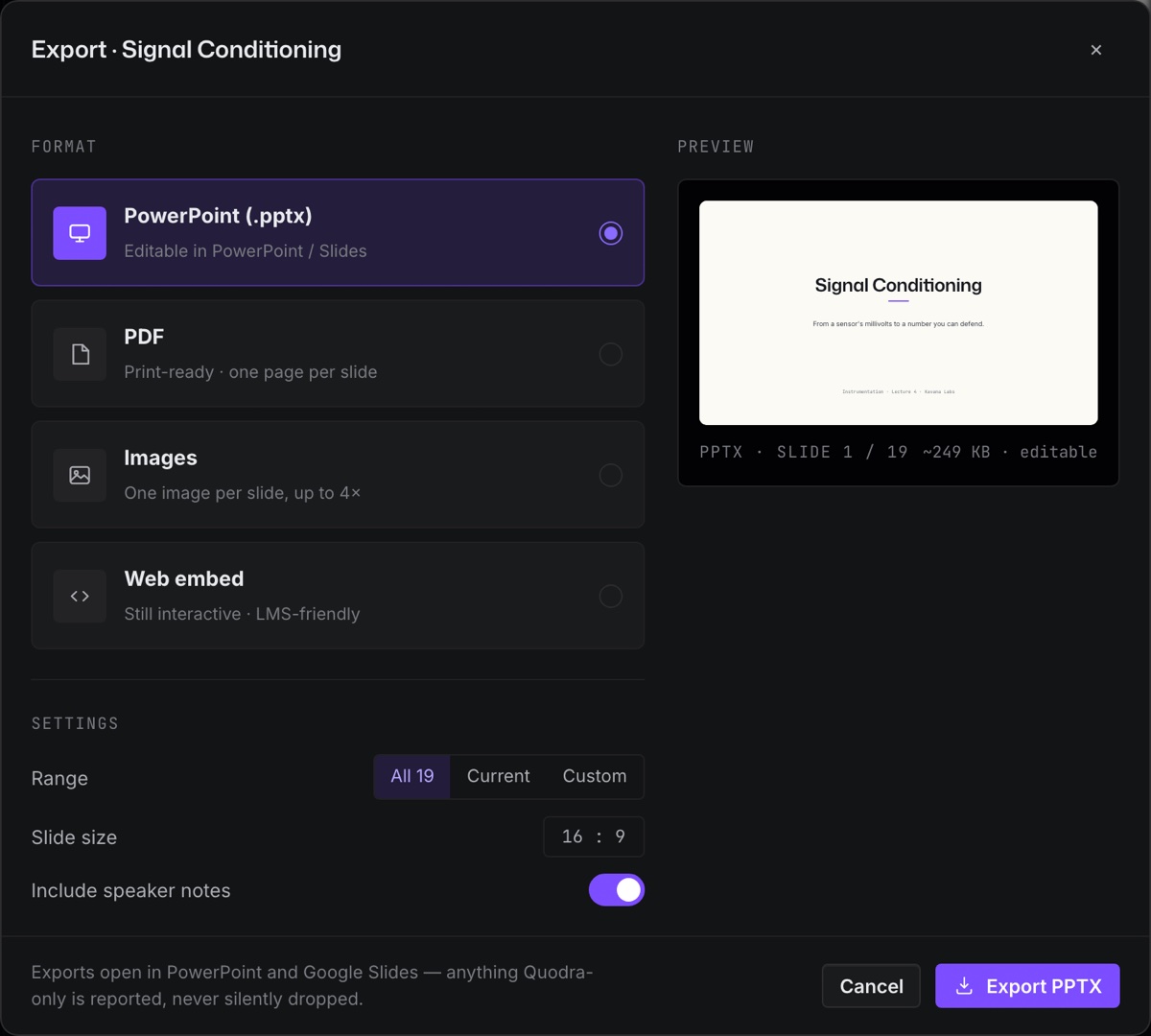
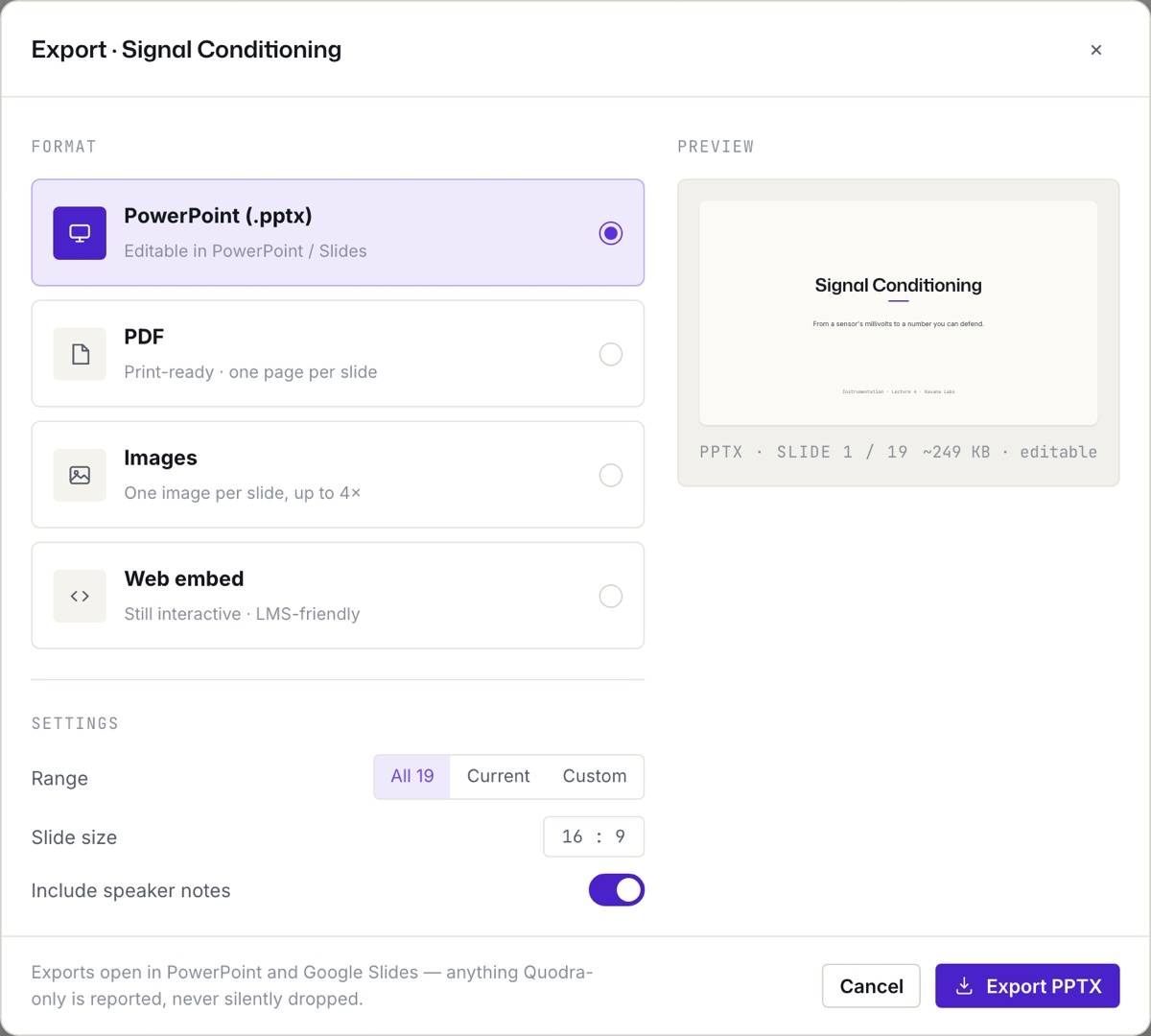
| Format | Output | Best for |
|---|---|---|
| PowerPoint (.pptx) | Native elements, captured images and fallbacks | Continuing work in PowerPoint or Google Slides, after reviewing the conversion. |
| Captured slide images inside PDF pages | A static handout at the selected resolution. | |
| Images | One image per slide, up to 4× | Figures for a paper, a poster, or another document. |
| Web embed | Read-only slide viewer with navigation | Showing a deck on a page or in an LMS. |
Every format except the embed takes a Range: All, Current, or Custom with an expression like 1-3, 5.
- PowerPoint (.pptx) — fixed at a
16 : 9slide size, with Include speaker notes on by default. - PDF — Page size of Slide 16:9, A4 or Letter; Resolution up to
3×; Encoding of PNG · lossless or JPEG · smaller with a quality slider; Notes pages to print a notes sheet after each slide; and Page numbers. - Images — Resolution up to
4×(that is3840 × 2160per slide), the same Encoding choice, and Transparent background for PNG. One slide downloads as a file; several arrive as one.zip, because browsers block a burst of separate downloads. - Web embed — needs a share link to point at, and offers to mint one if the deck has none. Then set Opens on slide, a Theme of Reader's, Dark or Light, a Width of Fill,
720pxor960px, and Allow full screen. Copy the Snippet — a plain iframe in a wrapper that holds 16:9 at any width — or Copy URL for hosts that build their own frame.
From the dashboard, a deck's menu also offers Export JSON, which downloads the complete document as .quodra.json — the format the importer above reads back losslessly.
What travels, and what doesn't#
- PDF and images are snapshots made from browser captures. PDF embeds those captures as PNG or JPEG images; slide content is not preserved as vector artwork or editable text. Resolution affects detail when zooming or printing. Run the cells you need before exporting: export does not rerun Python, and captures use the output available at that moment.
- PowerPoint carries the content as native PowerPoint parts wherever one exists: headings and text as text boxes with the first level-one heading marked as the slide's title, shapes as shapes, images as images, tables as tables, and supported charts as native charts. Equation plots use numeric XY coordinates; variable legends export their current literal text and values as static tables. These exports do not retain Quodra links. Invalid equation sources produce labelled placeholders and an Export review warning; a table chart without data is reported instead of guessed at.
- Scientific and interactive content in PowerPoint has limits. Parameter panels become static values. Code cells, equations, simulations, circuits, diagrams, molecules and computed artifacts use captured images where supported, with text or labelled placeholders when a capture is unavailable. Matter Lab objects currently export as labelled placeholders. Inline math in text currently falls back to LaTeX source. Check the exported file and the Export review before sharing it; these objects do not retain computation or interactive controls in PowerPoint.
- Web embed loads the shared deck into a read-only viewer with slide navigation. It does not run Python or the dependency engine; supported equation results, plots and legends are derived locally from saved inputs and settings. Reopening or reloading loads the available shared version. It has no editing or presenter controls and is not a synchronized live presentation session.
An export that had anything to say opens an Export review — the same dialog as the import report, listing placeholders and affected slides. It also reports missing chart data, unavailable equation outputs and externally linked images.
Use the editor or its presenter view for a live computation demo. A share link or embed is for viewing, and does not provide the same controls or execution environment.
Next#
- Presenting — present live instead of exporting.
- Collaboration — invite collaborators or create a viewing link.