
The editor
A slide is a canvas of independent objects, each with its own settings. This is where every control lives — the toolbar, the inspector, the layers, the rail, and the keys that drive them.
The slide is a canvas of objects#
A slide holds independent objects. Select one to move, resize, rotate, or edit it; select several and act on them together. With nothing selected, the inspector shows the settings for the slide itself.
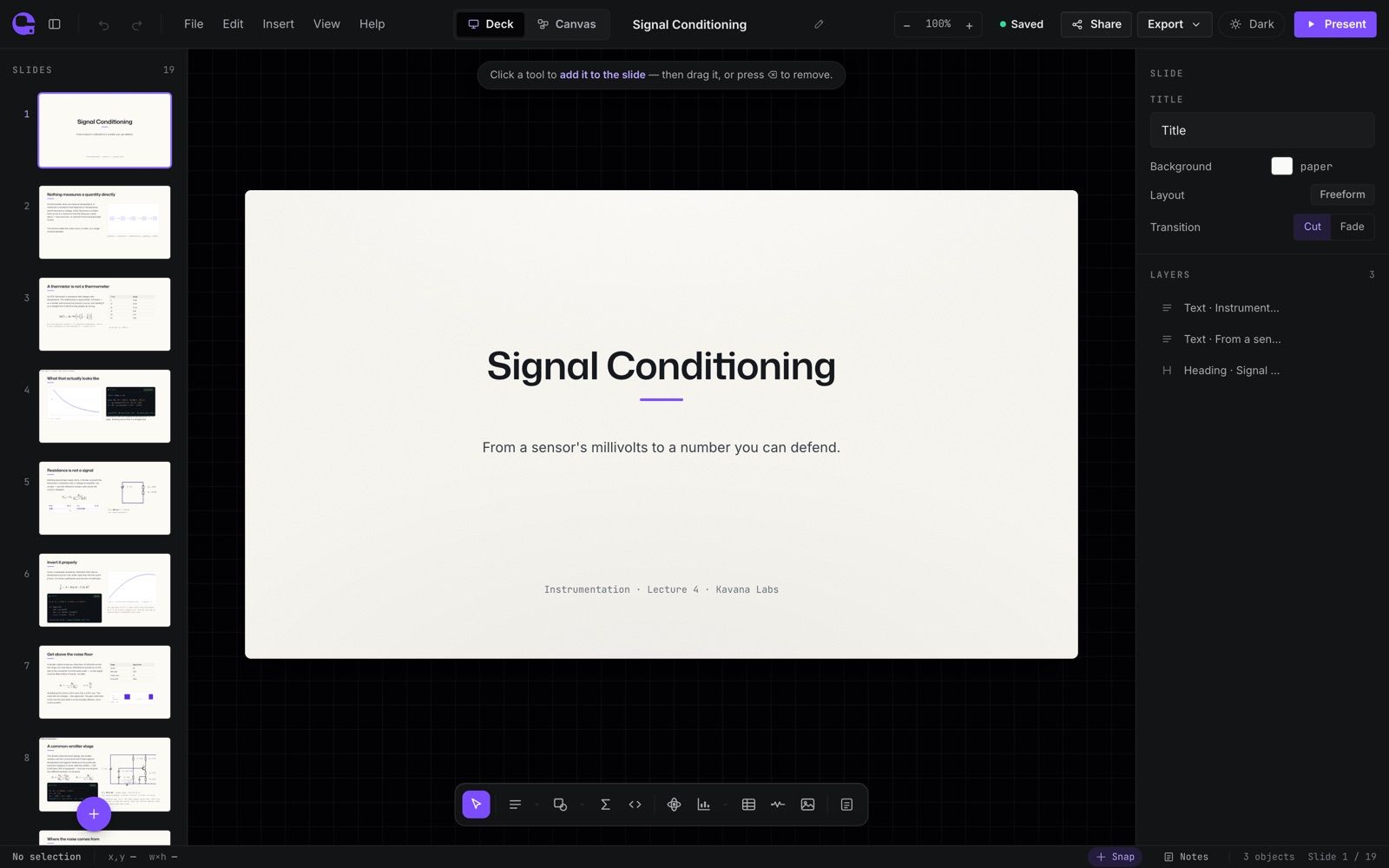
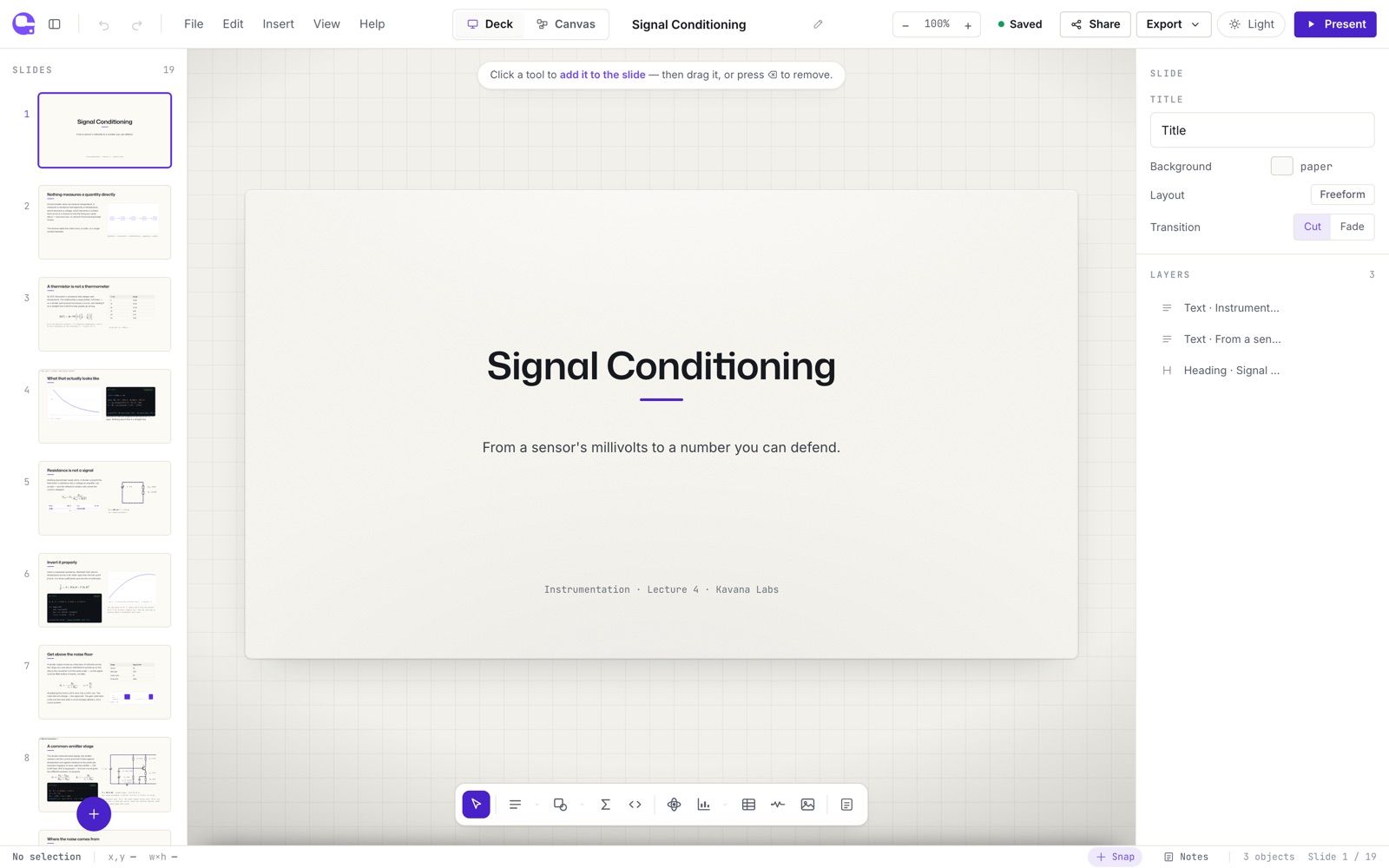
The top bar#
From the left: the Quodra mark (which takes you back to your decks), the slide-rail toggle, Undo and Redo, then the menu bar.
- File — Save now (
⌘S), Revision history…, Load example, Import JSON…, Export JSON, Export… (⌘E), Send feedback…, Present. - Edit — Undo (
⌘Z), Redo (⇧⌘Z), Duplicate (⌘D), Delete selected (⌫). - Insert — every object type Quodra knows, by name.
- View — Deck view, Canvas view, Hide/Show slide rail (
⌘\), Hide/Show inspector (⌥⌘\), Speaker notes, Comments, the theme switch (Paper theme / Dark theme), Code editor…, Python runtime…, Present. - Help — Take the editor tour, Keyboard shortcuts (
⌘/), Send feedback…
The centre holds the Deck / Canvas view toggle and the presentation title, which you can type into directly. A chip appears beside it when the deck is not simply yours: Shared with you · can edit on someone else's deck, Sample · read-only on a sample you have not yet edited.
On the right: who else is in the deck, the save badge, Share, Export, and Present.
The insert toolbar#
The floating pill along the bottom of the stage adds objects. Each button carries a tooltip with its shortcut, and tools with a caret open a menu of variants.


| Tool | Shortcut | Variants in its caret menu |
|---|---|---|
| Move | V | — |
| Text | T | Body text T, Heading H |
| Rectangle | R | Rectangle R, Circle O, Line L |
| Equation | E | — |
| Code | C | — |
| Parameter | P | — |
| Simulations | S | — |
| Chart | W | Bar, Line, Scatter, Area, Step, Diagram |
| Table | ⌘B | — |
| Circuit | ⌘U | — |
| Matter Lab | Y | Crystal structure Y, Phase diagram, Diffraction (XRD), Spectrum, Stress–strain, Gibbs energy, Trajectory (MD), Field playback, Ashby chart, Micrograph |
| Insert image | M | — |
| Comment | K | — |
Table is ⌘B and Circuit is ⌘U on purpose: ⌘T opens a browser tab and ⌘C is copy, and Quodra never takes a key the browser or the OS already owns. The tooltips and the key bindings are generated from one table, so a tooltip can never advertise a key that does nothing.
Every object kind#
The Insert menu lists every registered type, including the ones that have no button of their own:
| Object | What it is |
|---|---|
| Heading | Slide or section title |
| Text | Body copy block |
| Shape | Vector primitive |
| Image | Raster or vector figure |
| Table | Editable data grid — feeds charts |
| Chart | Plot bound to a data source |
| Diagram | Node-and-edge graph |
| Simulation | Live interactive model |
| Citation | Bibliography reference |
| Parameter | A panel of numbers, and what they produce |
| Equation | Typeset expression with Visual, Linear and LaTeX editing |
| Molecule | 2-D structure from SMILES |
| Code | Executable cell — output regenerates downstream |
| Artifact | Generated output from a cell |
| Circuit | A canonical circuit document, rendered live on the slide |
| Crystal | Crystal structure in 3-D |
| Diffraction | Powder XRD — imported or simulated |
| Phase diagram | Regions, state point, lever rule |
| Spectrum | Raman, FTIR, XPS, UV-Vis and more |
| Stress–strain | Mechanical test with derived properties |
| Gibbs energy | G–x curves and the common tangent |
| Ashby chart | Materials selection on log–log axes |
| Trajectory | MD playback with defect colouring |
| Field | 2-D scalar field played through time |
| Micrograph | Calibrated microscopy image |
Selecting#
- Click an object to select it; ⇧-click adds to or removes from the selection.
- Drag on empty slide draws a marquee; everything it touches is selected.
⌘Aselects every visible object on the slide. Hidden objects are left out.Escclears the selection, closes menus, and leaves inline editing.Enter, or a double-click, starts inline editing on a single selected object. Locked objects refuse.
Selected objects can be nudged with the arrow keys — one slide pixel at a time, or ten with ⇧ held. ⌘C / ⌘X / ⌘V copy, cut, and paste; ⌘D duplicates; ⌫ deletes. ⌘] brings the selection to the front and ⌘[ sends it to the back.
Guides, snapping, and the grip#
Dragging an object shows smart guides — a vertical or horizontal line with the coordinate it has snapped to, so alignment is a decision you can see. The Snap button in the status bar turns the behaviour off when you want free placement.
A selected object has corner handles for resizing and a rotate grip; hold ⇧ while dragging it for fifteen-degree steps. Rotation is also typed directly in the inspector, and Level puts it back to zero.
Zooming and panning#
The zoom control sits at the corner of the stage: Zoom out, the current percentage (click to reset), and Zoom in. ⌘+ and ⌘− step it, ⌘0 returns to a fitted hundred per cent, and pinch or ⌘-scroll zooms around the pointer. Hold Space to pan.
The right-click menu#
Right-clicking inside the editor opens Quodra's own menu rather than the browser's — except in text fields, where cut, paste, and spelling suggestions are worth more than anything we could offer.
- On empty slide — Select all objects, Duplicate slide, Add slide after, Show/Hide speaker notes.
- On an object — Duplicate, Bring to front, Send to back, Lock/Unlock, Show/Hide, Delete.
The inspector#
The panel on the right shows the settings for whatever is selected. Drag its inner edge to resize it; double-click that edge to return it to the default width. The width is remembered by this browser.
With one object selected the panel opens with the object's name, a one-line description of the type, and four buttons — Lock, Hide, Duplicate, Delete — followed by the fields for that kind:
- Text — Style (Body, Quote, Caption), Font (Sans, Serif, Mono), Color, Size, Weight, Align, Line height, List (None, Bullet,
1.). - Heading — Level (H1, H2, H3), Font, Size, Weight, Accent rule, Align.
- Shape — Shape (Rect, Ellipse, Line), Fill, Stroke, Stroke width, Corner radius.
- Image — Replace image…, Alt text, Fit (Contain, Cover, Fill), Rounding, Filter (None, Gray, Dim), Caption.
Charts, tables, equations, code cells, parameters, circuits, molecules, and every Matter Lab object have their own panels; those are covered on their own pages.
Below the type fields, and shared by every kind:
- Align — a six-button matrix: Left, Center H, Right, Top, Middle, Bottom.
- Position & size — X, Y, W, H and ROT, in slide pixels, with a Level button for rotation.
- Appearance — an opacity track, Fill, Corner radius, and Shadow.
With several objects selected the panel says how many, and the Align matrix and Layers stay available. With nothing selected it shows the slide: Title, Background, Layout (which reads Split · code on a slide that has a code cell and Freeform otherwise), and Transition — Cut or Fade.
Property fields show the values you authored. For an equation containing {{R}}, open LaTeX mode to edit the placeholder; the slide displays the parameter's current value.
Layers#
The Layers list at the foot of the inspector shows every object on the slide, front at the top, with its type and a snippet of its content. Click a row to select it — the reliable way to reach something sitting behind something else. Drag a row to restack it, or use the per-row buttons: Bring forward, Send backward, Lock, Hide.
The slide rail#
The rail on the left lists your slides as numbered miniatures with live previews. Click to go to one, drag to reorder, and use the button at the foot of the list to add a slide. Right-click a mini for Duplicate slide, Add slide after, and Delete slide — the last is refused when only one slide is left. ⌘\ hides and shows the rail.
The status bar#
Along the bottom: what is selected, the selected object's x,y and w×h, the Snap toggle, the Notes toggle for speaker notes, how many objects are on the slide, and which slide you are on.
Deck view and Canvas view#
When Canvas is enabled for your beta account and deployment, the centre of the top bar offers two views of the same document.
- Deck — the classic slide-by-slide view, with the rail and the stage.
- Canvas — an infinite plane with separately positioned objects and named camera frames. Present mode can glide the camera between frames. See The canvas view.
Undo#
Undo keeps recent local edits for the current document: ⌘Z steps back, ⇧⌘Z steps forward, and both are also in the Edit menu and on the top bar. The default history holds up to 200 entries. A continuous gesture is grouped into one entry. Use cloud revision history for older saved versions.
Saving and sync#
Everything autosaves. The badge beside Share is the whole state in one word — Saved, Saving…, Syncing…, Offline, Conflict, or Error — and clicking it opens the save centre, where Revision history lets you look back and restore an earlier version. Restoring adds a new revision, so history is never rewritten. ⌘S saves immediately.
When other people are in the deck, their cursors and selections appear live and edits flow both ways as they happen; the revision-checked save underneath stays the durable record. See Collaboration.
Imported and shared decks never run their Python automatically. A banner says Python is paused for this external deck until you review the cells and press Trust and run.